
Sentence Mechanics for Kids – Free PDF Worksheets with Answers
Before children start forming full sentences, they must learn the basic rules of writing sentences correctly. These rules are called sentence mechanics.
In this worksheet, kids will learn three important skills by fixing sentences:
- Using capital letters correctly
- Adding full stops at the end of sentences
- Using commas to separate items
This forms the foundation for all sentence writing and grammar learning.
What Fix The Sentences worksheet teaches
This worksheet is designed for Grade 1–2 learners and focuses on early writing skills.
Children will practice:
✔ Starting a sentence with a capital letter
✔ Ending a sentence with a full stop
✔ Using commas in simple lists
Why these skills are important
Before kids learn sentence structure or word order, they must understand:
- A sentence must start correctly
- A sentence must end correctly
- Words in a list need separation
Without this foundation, sentence formation becomes confusing.
Capital Letters (Start of Sentence)
Rule 1:
Every sentence begins with a capital letter.
Examples:
- she is reading a book ❌
- She is reading a book. ✔
- the dog is barking ❌
- The dog is barking. ✔
Rule 2:
Proper nouns always start with a capital letter.
Proper nouns are special names of people, places, or things.
Because they are special, we always begin them with a capital letter.
- John ✔
- India ✔
- Monday ✔
- Paris ✔
- john ❌
- india ❌
- monday ❌
- paris ❌
You can explore more about proper nouns in this worksheet here.
Full Stop (End of Sentence)
Rule:
Every complete sentence ends with a full stop (.)
Examples:
- I like mangoes ❌
- I like mangoes. ✔
- They are playing football ❌
- They are playing football. ✔
Commas
Rule 1:
Commas are used to separate items in a list.
Examples:
- I like apples mangoes bananas ❌
- I like apples, mangoes, bananas. ✔
- She has a pen pencil and eraser ❌
- She has a pen, pencil and eraser. ✔
Rule 2:
Commas are used in direct address (calling someone).
Examples:
Clara, come here.
Please sit down, Rahul.
Rule 3:
Commas are used after greetings or names in letters/messages.
Examples:
Dear Mom,
Hello, John, how are you?
Worksheet Activities
Fix Capital Letters
Rewrite correctly:
- she is reading a book.
- the dog is barking.
- i like ice cream.
Correct Answers:
- She is reading a book.
- The dog is barking.
- I like ice cream.
Add Full Stops
Rewrite correctly:
- I like mangoes
- They are playing football
- We are going to school
Correct Answers:
- I like mangoes.
- They are playing football.
- We are going to school.
Fix Capital Letters + Full Stops
- my brother is sleeping
- i like sarah
- she is eating breakfast
Correct Answers:
- My brother is sleeping.
- I like Sarah.
- She is eating breakfast.
Commas
Rewrite correctly:
- I like apples mangoes and bananas
- She has a pen pencil and eraser
- We bought books pens notebooks
Correct Answers:
- I like apples, mangoes and bananas.
- She has a pen, pencil and eraser.
- We bought books, pens, notebooks.
Download the free worksheet
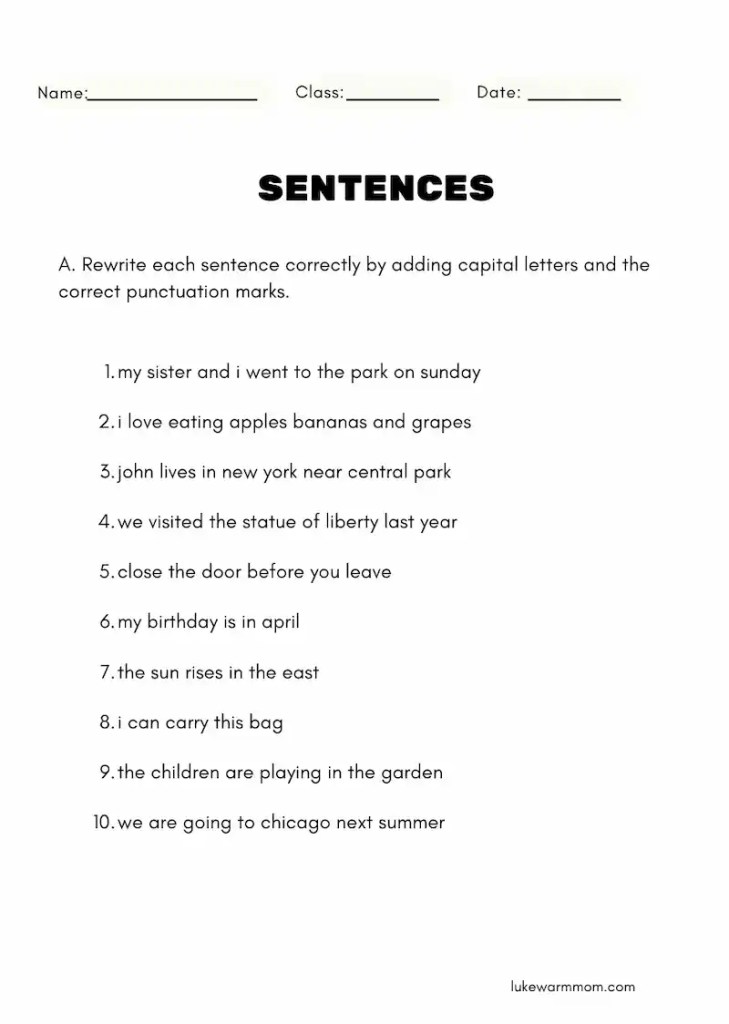
Answers:
- My sister and I went to the park on Sunday.
- I love eating apples, bananas and grapes.
- John lives in New York near Central Park.
- We visited the Statue of Liberty last year.
- Close the door before you leave.
- My birthday is in April.
- The sun rises in the east.
- I can carry this bag.
- The children are playing in the garden.
- We are going to Chicago next summer.
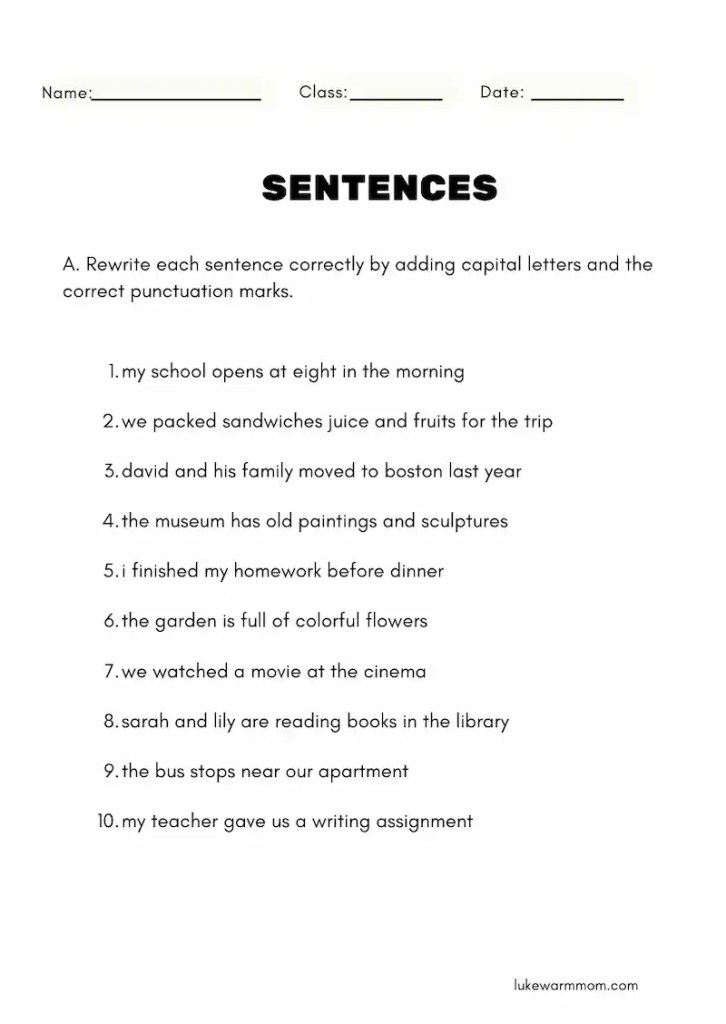
Answers:
- My school opens at eight in the morning.
- We packed sandwiches, juice and fruits for the trip.
- David and his family moved to Boston last year.
- The museum has old paintings and sculptures.
- I finished my homework before dinner.
- The garden is full of colorful flowers.
- We watched a movie at the cinema.
- Sarah and Lily are reading books in the library.
- The bus stops near our apartment.
- My teacher gave us a writing assignment.
Teaching Tips for Parents / Teachers
- Read each sentence aloud before starting
- Ask: “Where does the sentence begin?”
- Ask: “Where does it end?”
- Encourage children to read their corrected sentence aloud
- For commas, pause slightly while reading items
- Do the first example together as guidance
Learning Reminder for Kids
- Sentences start with a capital letter
- Sentences end with a full stop
- Commas help us list things clearly
- Good sentences must be easy to read and understand
Q&A (Grade 1–2)
Q1: What is a capital letter used for?
A: A capital letter is used at the beginning of a sentence and for special names (proper nouns).
Q2: What is a full stop?
A: A full stop is used at the end of a sentence.
Q3: When do we use a comma?
A: We use a comma to separate items in a list or when calling someone by name.
Q4: Which sentence is correct?
a) she is reading a book
b) She is reading a book
A: b) She is reading a book
Q5: Add the correct punctuation:
I like apples mangoes bananas
A: I like apples, mangoes, and bananas.
Q6: Fix the sentence:
hello john come here
A: Hello, John, come here.
Q7: What comes at the end of a sentence?
A: A full stop (.)
Q8: Why do we use commas in a list?
A: To separate items clearly so the sentence is easy to read.
Build strong grammar foundations with our full series of Sentence Structure Worksheets for Early Elementary, including punctuation, word order, and sentence formation practice.
You May Also Like
- Helping Your Kid Learn Independently: A Parent’s Guide
- School Assignment Trackers for Kids
- Free Picture Comprehension Worksheets for Kids (Grade 1–3) + Printable PDF
- From Playroom to Study Space: Setting Up a Kids Study Area That Works
- Storytelling for Elementary School Kids
- Parts of Speech Worksheets for Kids (Free Printable PDFs)




Leave a Reply