
Object pronouns replace nouns that receive the action in a sentence. Learning object pronouns helps children write shorter, smoother sentences and avoid repeating names over and over again.
Examples of object pronouns include:
- me
- you
- him
- her
- it
- us
- them
In this post, you’ll find printable object pronoun worksheets that help young learners practice using pronouns correctly in everyday sentences.
What Are Object Pronouns?
Object pronouns take the place of a noun that receives the action.
Examples:
- Mom called Sarah. → Mom called her.
- I saw Tom at the park. → I saw him at the park.
- We found the keys. → We found them.
The pronouns her, him, and them replace the nouns and make the sentences easier to read.
Object Pronouns List
| Subject Pronoun | Object Pronoun |
|---|---|
| I | me |
| You | you |
| He | him |
| She | her |
| It | it |
| We | us |
| They | them |
Object Pronouns Examples for Kids
- Dad helped me.
- I called him.
- We saw them at school.
- Please give it to me.
- The teacher praised her.
- Grandma invited us for dinner.
Why Object Pronouns Are Important
Object pronouns help students:
- Avoid repeating nouns
- Write more naturally
- Improve grammar skills
- Understand sentence structure
- Build confidence in writing
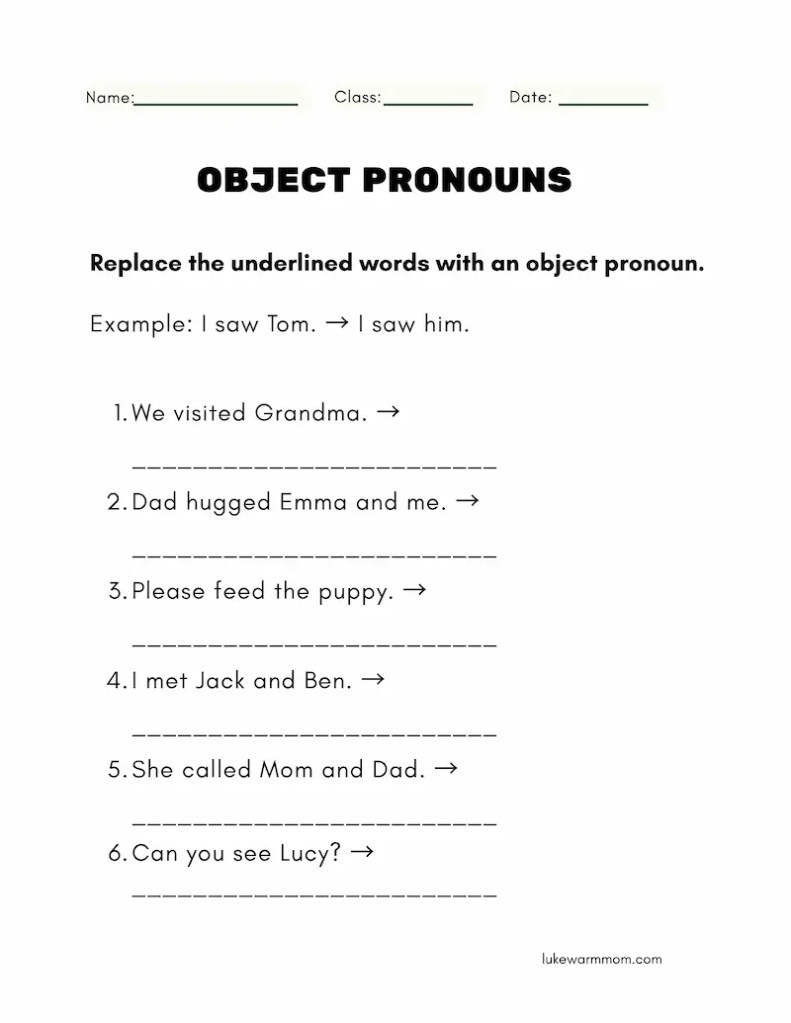
Download the Object Pronouns Worksheets
These printable worksheets provide simple practice with:
- me
- you
- him
- her
- it
- us
- them
They are suitable for Grade 1, Grade 2, ESL learners, homeschooling, literacy centers, and extra grammar practice.
How to Teach Object Pronouns to Kids
Object pronouns can be tricky because children often learn subject pronouns (I, he, she, they) first. The easiest approach is to start with real-life examples and then show how object pronouns replace names.
Step 1: Start with Names
Write a simple sentence:
I see Sarah.
Ask:
“Who do I see?”
Answer: Sarah
Now replace Sarah with a pronoun:
I see her.
Explain that her is an object pronoun because it receives the action.
Step 2: Use a Subject vs. Object Comparison

Examples:
- He kicked the ball.
- I saw him.
- She is my friend.
- I called her.
Step 3: Act It Out
Children learn grammar better when they move.
Say:
- “I am calling Emma.”
- “Now let’s replace Emma.”
Students answer:
- “I am calling her.”
Try:
- I see Tom. → I see him.
- Dad helped Lily and Max. → Dad helped them.
- Grandma invited Mom and me. → Grandma invited us.
Step 4: Use the “Who Receives the Action?” Question
Teach students to ask:
Who is receiving the action?
Example:
“The teacher helped Jake.”
Who received the help?
Jake.
Replace Jake:
“The teacher helped him.”
Step 5: Practice with Pictures
Show pictures of children, animals, and objects.
Ask:
- Do you see the dog?
- Yes, I see it.
- Do you see the girls?
- Yes, I see them.
Visuals make object pronouns easier to understand.
Step 6: Try Sentence Frames
Give students simple patterns:
- I see _____.
- Mom called _____.
- The teacher helped _____.
- Please give _____ the book.
Students choose:
me, him, her, us, them, or it.
Step 7: Play a Replacement Game
Write:
- I saw Sarah.
- I saw Tom.
- I saw the puppies.
- I saw Mom and Dad.
Students replace the nouns:
- her
- him
- them
- them
This helps them understand the purpose of object pronouns quickly.
Download the Object Pronouns PDF worksheet

Common Mistakes
Children often say:
❌ Me went to school.
Correct:
✅ I went to school.
Children may also say:
❌ I called she.
Correct:
✅ I called her.
A good reminder is:
Subjects do the action. Objects receive the action.
Quick Teaching Tip
Don’t teach all seven object pronouns at once. Start with:
- him
- her
- them
These are the easiest for children to recognize in sentences. Once they understand the idea of replacing names, introduce:
- me
- us
- it
- you
Gradually building the skill usually works better than teaching the entire chart in one lesson.
Frequently Asked Questions
What is an object pronoun?
An object pronoun replaces a noun that receives the action in a sentence.
What are the object pronouns?
The object pronouns are: me, you, him, her, it, us, and them.
What is the difference between subject and object pronouns?
Subject pronouns do the action.
Example: She runs.
Object pronouns receive the action.
Example: I called her.
Are object pronouns taught in Grade 1?
Many Grade 1 and Grade 2 students begin learning basic pronouns, including object pronouns, through simple reading and writing activities.
How can children practice object pronouns?
Children can practice by completing worksheets, replacing nouns with pronouns, matching activities, and sentence-writing exercises.
Related Grammar Worksheets
- am, is, are + ing Worksheets for Grade 1 with Answers
- Nouns for Grade 1 — Fun Noun Worksheets + Free Printable PDF
- Verb Worksheets for Grade 1 – Free Printable Verb Worksheets with Answers
- Fix the Sentence Worksheets for Grade 1
- Fun Picture Comprehension Worksheets for Kids (Grades 1–3)
- I and You Pronouns for Grade 1 (Fun Worksheets & Activities)
If you found this worksheet helpful, feel free to save it, print it, or share it with other parents and teachers
Happy learning!
If you’re looking for more learning worksheets for early elementary children, you can explore our growing collection of skill-based practice resources designed for ages 5–8. From language and reading skills to simple grammar concepts like parts of speech, these worksheets are created to support gentle, stress-free learning at home.



Leave a Reply