

Understanding how sentences are built is a major milestone for early readers. For many Grade 1 students, looking at a string of words and turning them into a logical thought feels like solving a secret code.
What are Scrambled Sentences?
Scrambled sentences are groups of words that belong together but have been placed out of order. To “unscramble” them, a student must rearrange the words so they follow the rules of grammar and make sense.
In Grade 1, we focus on simple Subject + Verb + Object structures and basic connecting words like because, if, and when.
Why are Scrambled Sentences Important for Grade 1?
Moving beyond just reading single words, sentence rearranging helps 6- and 7-year-olds develop several core literacy skills:
- Grammar Awareness: Kids learn naturally that the “who” (subject) usually comes before the “doing” (verb).
- Punctuation Mastery: It reinforces that every sentence must start with a capital letter and end with a mark like a period or question mark.
- Reading Comprehension: Students can’t unscramble a sentence unless they actually understand what the words mean together.
- Logical Thinking: It encourages kids to ask, “Does this make sense?” as they work through the puzzle.
How to Unscramble a Sentence: A Step-by-Step Strategy
Teaching Grade 1 students a system makes the task much less overwhelming. Use these three “Detective Steps”:
1. Find the “Engine” (The Capital Letter)
Every sentence starts with a capital letter. Instruct your students to look for the word that starts with a big letter—that is almost always the first word of the sentence.
2. Find the “Caboose” (The Punctuation)
Look for the word that has a period, exclamation point, or question mark attached to it. That word is the “caboose” and must go at the very end.
3. Build the Middle
Now, look at the remaining words. Ask: “Who is the sentence about?” and “What are they doing?”
Example:
likes / The dog / to run
- Step 1: “The” has a capital. It’s first.
- Step 2: “run” has no period, but “run.” (if provided with punctuation) would be last.
- Step 3: The dog… likes… to run.
Expert Teaching Tips for the Classroom or Home
- Use Word Cards: Instead of just writing on paper, write each word on a separate index card. Let the child physically move the cards around until the sentence “looks right.”
- The “Silly Sentence” Test: Read a scrambled sentence aloud exactly as it is written (e.g., “Run dog the likes”). Kids find this hilarious, and it helps them hear why the order matters.
- Color-Code the Parts: Try writing subjects in blue and verbs in red. This visual cue helps them recognize the patterns of English sentences faster.
- Cut and Paste: Turning an unscrambling task into a craft project keeps little hands busy and helps with fine motor skills.
Scrambled Sentence Practice for Beginners
If you are looking for a quick way to practice today, try these simple Grade 1 jumbled sentences:
- is / sun / The / hot → The sun is hot.
- I / blue / like / cars → I like blue cars.
- can / jump / The / frog → The frog can jump.
- We / to / the / go / park → We go to the park.
Download free PDF worksheets for Scrambled Sentences

Answers:
- The dog likes to run.
- The apple is big and red. (Or: The apple is red and big.)
- I sleep when I am tired.
- My mom smiles if I help.
- The cat jumps because it is happy.
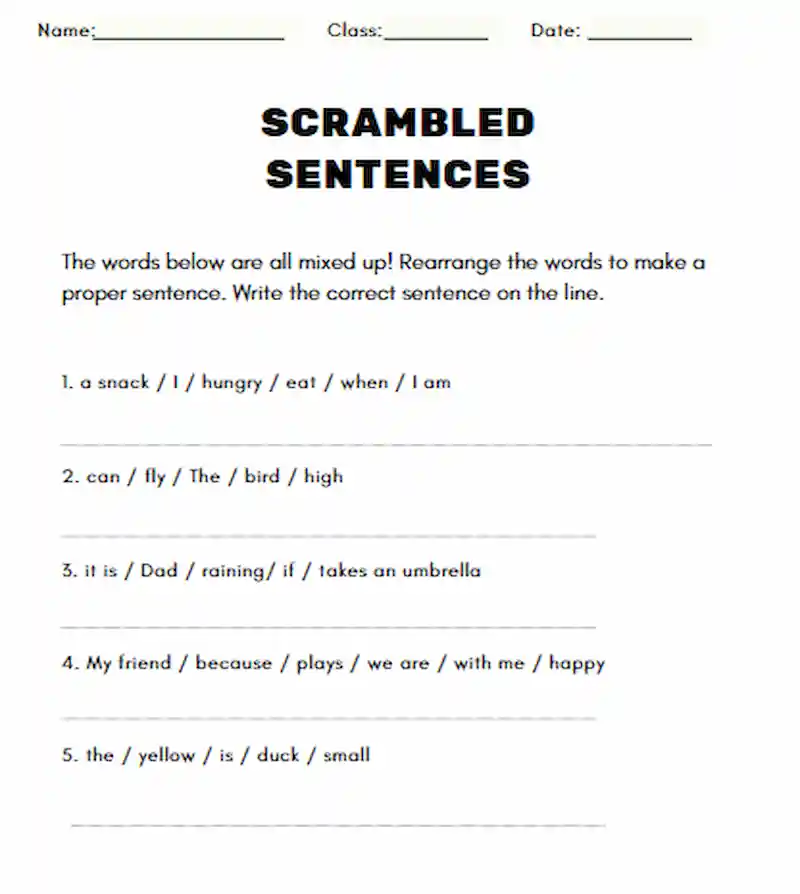
Answers
- I eat a snack when I am hungry.
- The bird can fly high.
- Dad takes an umbrella if it is raining.
- My friend plays with me because we are happy.
- The small duck is yellow. (Also correct: The yellow duck is small) – Make sure kids start the sentence in capital letter.
Looking for more practice? Find a variety of Sentence Structure Worksheets for Kids and writing activities on this page.
Final Thoughts for Parents and Teachers
Teaching scrambled sentences isn’t just about grammar—it’s about giving children the tools to express themselves clearly. By turning sentence structure into a game, you take the “work” out of worksheets and replace it with genuine “aha!” moments.
Frequently Asked Questions: Scrambled Sentences
Q: At what age should kids start unscrambling sentences?
A: Most children are ready for simple 3-word scrambled sentences in Kindergarten or early Grade 1. Once a child can recognize common sight words and understands that a sentence represents a complete thought, they can begin practicing.
Q: Why does my child struggle with rearranging sentences?
A: It’s usually one of two things: reading fluency or logic. If they can’t read the words easily, they won’t know how they fit together. Try reading the words aloud for them first, then let them decide the order. This shifts the focus from “decoding” to “logic.”
Q: How do I teach a 1st grader to find the first word in a scrambled sentence?
A: Teach them to be a “Capital Letter Detective.” Every proper English sentence begins with a capital letter. If they find the word with the big letter, they’ve found the “Engine” of their sentence train!
Q: Is there a “cheat code” for finding the end of the sentence?
A: Yes! Look for the “Caboose.” In Grade 1 worksheets, the punctuation mark (period, question mark, or exclamation point) is usually attached to the final word. Finding the start and the end first makes the middle much easier to solve.
If you found this worksheet helpful, feel free to save it, print it, or share it with other parents and teachers.
More Grade 1-3 Worksheets You May Like
- Nouns for Grade 1 — Fun Naming‑Words Worksheet + Free Printable PDF
- Verb Worksheets for Grade 1 – Free Printable Verb Worksheets with Answers
- Parts of Speech Worksheets for Kids (Free Printable PDFs)
- Capital Letters, Full Stops & Commas (Grade 1–2 Worksheet)
- Sentence Structure Worksheets for Kids (Grade 1–5)
Happy learning!
If you’re looking for more learning worksheets for early elementary children, you can explore our growing collection of skill-based practice resources designed for ages 5–8. From language and reading skills to simple math concepts, these worksheets are created to support gentle, stress-free learning at home.




Leave a Reply