
Teaching prepositions to young children can feel tricky at first. Words like in, on, and under seem simple, but for Grade 1 kids, they are still learning how to understand space and position.
This guide will help you explain prepositions in a simple, child-friendly way — with examples, activities, and free printable worksheets.
What Are Prepositions? (Grade 1 Definition)
Prepositions are position words. They tell us where something is or where something happens.
For young children, it’s easier to call them position words instead of using grammar terms.
👉 Simple way to explain:
A preposition tells us where something is.
Examples of Prepositions for Grade 1
Here are the most common prepositions children learn first:
- in
- on
- under
- behind
- near
Simple Sentences:
- The cat is on the chair
- The ball is under the table
- The toy is in the box
- The boy is near the car
- The dog is behind the door
These words help answer the question: “Where?”
Why Are Prepositions Important for Kids?
Learning prepositions helps children understand how sentences are built. When children can describe where things are, they begin to form clearer and more meaningful sentences.
Prepositions also help children:
- Understand space and position
- Speak more clearly
- Describe things around them
- Build strong sentence skills
How to Explain Prepositions to a Child
You don’t need definitions or rules.
The best way is to show and tell.
Try this:
- Put a toy on a table
- Hide a ball under a chair
- Place a book in a bag
Then ask:
👉 “Where is it?”
Children learn faster when they see and do, not just listen.
Easy Activities to Teach Prepositions
Keep it playful and simple.
1. Toy Game
Use toys and ask:
- “Put the car under the chair”
- “Place the doll on the bed”
2. Ask & Answer
Ask:
👉 “Where is the teddy?”
Let your child answer using:
- in
- on
- under
3. Picture Worksheets
Children look at a picture and choose the correct word.
This helps them connect words with real-life situations.
4. Draw & Learn
Ask your child:
- “Draw a ball under the table”
- “Draw a cat on the wall”
This checks real understanding (not guessing).
Common Types of Prepositions (Simple for Kids)
For Grade 1, focus only on position words.
Later, children may learn:
- Time (on Monday, in the morning)
- Direction (into, onto)
But for now, keep it simple:
👉 Where something is
Prepositions Worksheet (Free Printable)
These worksheets are designed for:
- Grade 1 students
- Early learners
- ESL children
What’s included:
- Picture-based questions
- Fill in the blanks
- Circle the correct answer
- Match words with images
Keep it short and visual — one page is enough.

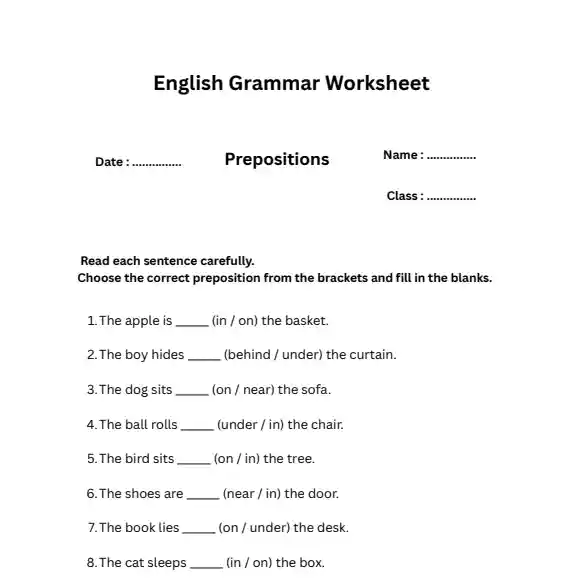
If you enjoyed these worksheets, you can download the complete Parts of Speech worksheet bundle with 18 printable worksheets for free. Just sign up below and we’ll send you access to the full bundle so your child can continue practicing grammar lessons.

Answer Key: Position Words (Prepositions) – Grade 1
Below are the correct answers for the worksheet questions. Use this to check your child’s work or to help explain prepositions like in, on, under, near, and behind clearly.
Prepositions Worksheet 1
- on
- under
- in
- near
- behind
Prepositions Worksheet 2
- in
- behind
- on
- under
- on
- near
- on
- in
- under
- near
Tips for Parents and Teachers
- Start with real objects before worksheets
- Repeat words naturally in conversation
- Avoid correcting too much — model the right sentence instead
- Keep learning playful, not stressful
Children don’t need perfect grammar.
They need practice, repetition, and confidence.
FAQs – Prepositions for Grade 1
What is a preposition for Grade 1?
A preposition is a word that tells us where something is, like in, on, or under.
What are examples of prepositions?
Common examples include:
- in
- on
- under
- near
- behind
How do you teach prepositions to kids?
Use toys, real objects, and simple questions like:
👉 “Where is the ball?”
At what age do children learn prepositions?
Children usually start learning prepositions in Kindergarten and Grade 1.
Prepositions are one of the early building blocks of language. When children understand where things are, they become more confident in speaking and forming sentences.
Keep it simple. Keep it visual. And most importantly — keep it fun.
More Grade 1 Worksheets You May Like
- Nouns for Grade 1 — Fun Naming‑Words Worksheet + Free Printable PDF
- Learn Articles A, An, and The – Free Worksheets for Grade 1 Kids
- Verbs for Grade 1 – Free Printable Action Verb Worksheets with Answers
- One and Many Worksheets for Grade 1 (Free Printable PDF)
- Am, Is, and Are Helping Verbs for Grade 1
- Describing Words Worksheets for Class 1 With Answers(Free Printable PDFs)
- He, She, It Pronoun Worksheets for Class 1 (Free Printable PDF)
- Free Personal Pronoun Worksheets: He, She, It, I, You, We & They
If you’d like to save this for later, feel free to bookmark or share it with another parent or teacher who may find it useful.
Download the free worksheet now and start a fun learning session today!
Don’t forget to share your child’s stories in the comments—we’d love to hear them!
Subscribe for more tips, activities, and guidance to support your child’s learning and growth.
If you’re looking for more learning worksheets for early elementary children, you can explore our growing collection of skill-based practice resources designed for ages 5–8. From language and reading skills to simple parts of speech or sentence structure concepts, these worksheets are created to support gentle, stress-free learning at home.



Leave a Reply