

What are “I” and “You”?
I and You are personal pronouns.
They are small words we use instead of names when we talk.
I means the person who is speaking
You means the person we are talking to
Simple Explanation for Kids
I = me
You = the person I am talking to
Easy Examples
- I am reading.
- I have a book.
- You are my friend.
- You are playing.
Understanding the Difference
This is the most important part
| Situation | Word to Use |
|---|---|
| When I talk about myself | I |
| When I talk to someone | You |
Try This (Fun Activity)
Say these aloud:
- (Point to yourself) → “___ am happy” → I
- (Point to your child) → “___ are smiling” → You
Kids learn faster when they act it out
Download I and You Worksheet Here

Answer Key
- I am going to the park.
- Are you ready for school?
- I have a new bike.
- Did you finish your homework?
- You can play with me.
- Do you want some ice cream?
- I am reading a book.
- Can you help me with this?
- I like pizza and burgers.
- Are you coming to the party?
Hands-On Pronoun Cut and Paste Worksheets | Grade 1 & 2 Grammar Bundle

What to Learn Next
Once your child understands I and You, they can move on to:
- He, She, It (for people and things)
- We and They (for groups)
- Simple sentences using pronouns
Q&A: Learn “I” and “You”
Q1. When should I use “I”?
A1. Use “I” when you are talking about yourself.
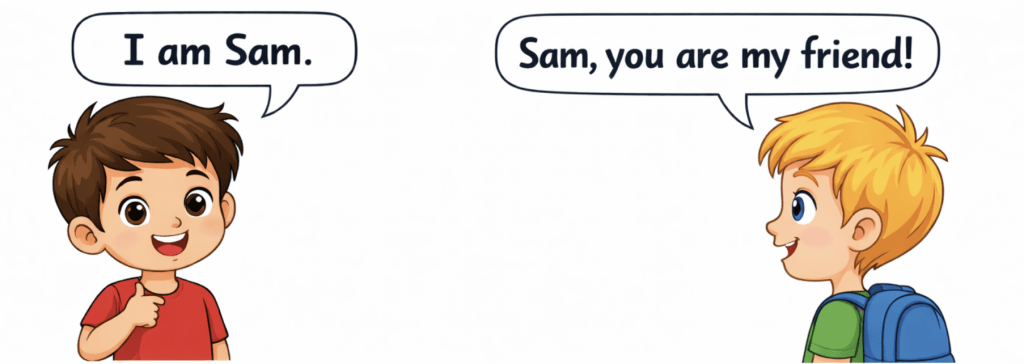
Example: “___ am Sam.” → Sam is talking about himself, so we write I.
Q2. When should I use “You”?
A2. Use “You” when you are talking to someone else.
Example: “___ are my friend.” → Sam is talking to his friend, so we write You.
Q3. Can “I” and “You” be used in the same sentence?
A3. Yes! Example: “___ am Sam and ___ are my friend.”
Here, Sam is talking about himself (I) and his friend (You).
Q4. How can I remember the difference?
A4. Point to yourself when saying “I” and point to the other person when saying “You.”
Q5. Why is it important to use “I” and “You” correctly?
A5. It helps others understand who is speaking and who is being spoken to.
Learning I and You helps children understand who is speaking and who is being spoken to. When children can identify and use “I” for themselves and “You” for others correctly, they begin to communicate more clearly in sentences.
With simple practice and engaging activities like these Grade 1 I and You worksheets, students can confidently recognize, write, and use “I” and “You” in their own sentences.
If you found this worksheet helpful, feel free to save it, print it, or share it with other parents and teachers.
Happy learning!
If you’re looking for more learning worksheets for early elementary children, you can explore our growing collection of skill-based practice resources designed for ages 5–8. From language and reading skills to simple grammar concepts, these worksheets are created to support gentle, stress-free learning at home.




Leave a Reply