
Learning the difference between one and many helps children build important vocabulary and early grammar skills. Before students learn the terms singular and plural nouns, they often begin by identifying whether there is one item or many items.
This simple concept helps young learners describe the world around them and prepares them for more advanced grammar lessons.
What Do One and Many Mean?
One means a single person, animal, place, or thing.
Examples:
- One apple
- One dog
- One book
- One flower
Many means more than one person, animal, place, or thing.
Examples:
- Many apples
- Many dogs
- Many books
- Many flowers
One and Many Examples
| One | Many |
|---|---|
| cat | cats |
| dog | dogs |
| book | books |
| pencil | pencils |
| bird | birds |
| flower | flowers |
When we talk about many things, we often add s to the end of the word.
Examples
- One cat → Many cats
- One ball → Many balls
- One tree → Many trees
Practice Together
Look at the word and decide if it means one or many.
- apple
- books
- dog
- flowers
- pencils
Answers:
- One
- Many
- One
- Many
- Many
Teaching Tips for Parents and Teachers
Use Real Objects
Young children learn best when they can see and touch objects.
Place one pencil on the table and say:
One pencil.
Then place several pencils on the table and say:
Many pencils.
Repeat with crayons, blocks, books, or other classroom items.
Use Picture Cards
Show a picture of one object and then a picture of several objects.
Ask:
- Is this one or many?
- How do you know?
This helps children connect words to visual examples.
Practice During Reading Time
Picture books provide many opportunities to talk about one and many.
Ask questions such as:
- Do you see one bird or many birds?
- Is there one flower or many flowers?
Encourage Complete Sentences
Instead of saying only “many,” encourage children to answer using complete sentences.
For example:
✅ I see many flowers.
✅ There is one dog.
This builds both grammar and speaking skills.
Common Mistakes
Children sometimes forget that many means more than one.
❌ One books
✅ One book
❌ Many dog
✅ Many dogs
Encourage students to look carefully at the picture and count the objects before answering.
Skills Practiced in This Worksheet
This worksheet helps students practice:
- One and many concepts
- Early grammar skills
- Singular and plural nouns
- Vocabulary development
- Sentence building
- Visual discrimination
Free One and Many Worksheet
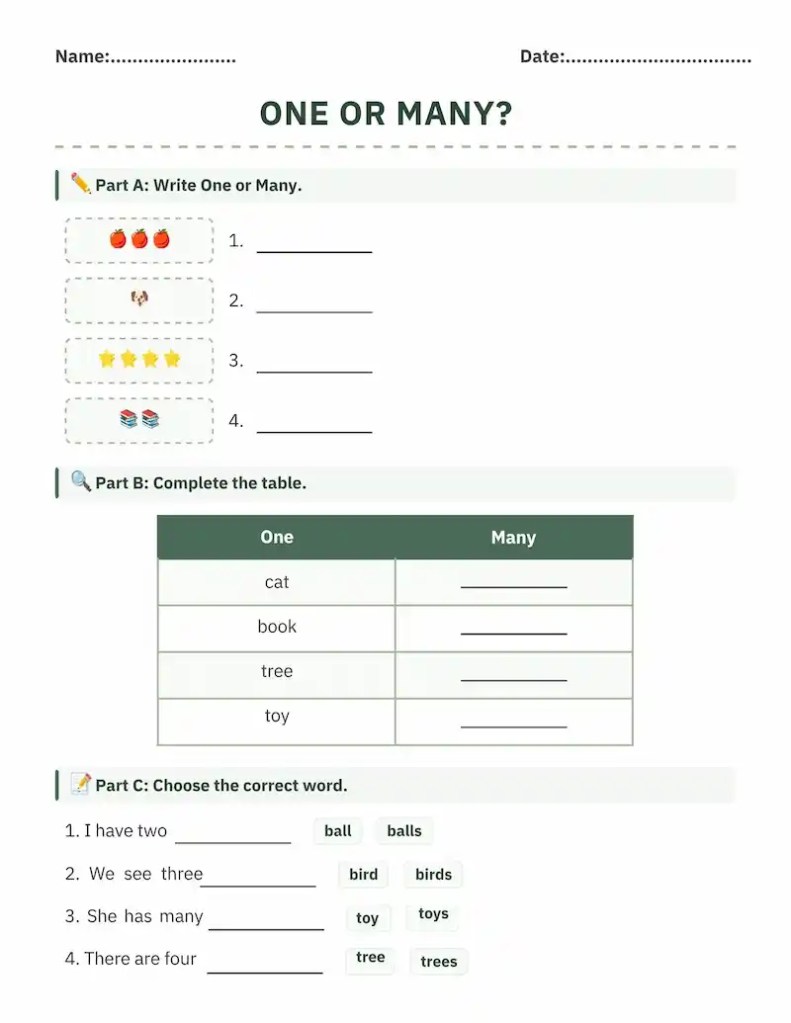
Use the printable worksheet below to help students practice:
- Identifying one and many
- Matching pictures and words
- Completing simple sentences
- Sorting singular and plural nouns
This worksheet is suitable for classroom lessons, independent practice, homework, literacy centers, and homeschool activities.
Related Grammar Worksheets
- Singular and Plural Nouns Worksheets
- Many and Much Worksheets for Kids: Fun Grammar Practice with Free Printable PDF
- This and These Worksheets
- Nouns for Grade 1 — Fun Noun Worksheets + Free Printable PDF
- Free Personal Pronoun Worksheets: He, She, It, I, You, We & They
- Sentence Structure Worksheets
- Am, Is, and Are Helping Verbs Worksheets
- am, is, are + ing Worksheets for Grade 1 with Answers ( Free Printable PDFs)
FAQ
What does one and many mean?
One means a single person, place, animal, or thing. Many means more than one.
Is one and many taught in Grade 1?
Yes. Many first-grade students learn the concepts of one and many before studying singular and plural nouns in greater detail.
How can children practice one and many?
Children can practice by looking at pictures, counting objects, matching words, and completing simple worksheets.
Why is learning one and many important?
Understanding one and many helps children develop vocabulary, grammar skills, and a foundation for learning singular and plural nouns.
Learning one and many helps children understand actions and build clear, meaningful sentences. With simple practice and fun activities, Grade 1 kids can confidently identify singular and plural nouns and use them correctly in their everyday speaking and writing.
If you found this worksheet helpful, feel free to save it, print it, or share it with other parents and teachers
Happy learning!
If you’re looking for more learning worksheets for early elementary children, you can explore our growing collection of skill-based practice resources designed for ages 5–8. From language and reading skills to simple grammar concepts like parts of speech, these worksheets are created to support gentle, stress-free learning at home.



Leave a Reply