

Learning pronouns helps children speak and write more clearly. Words like he, she, him, her, his, and her are used every day, but they can be confusing for young learners at first.
With simple explanations and fun practice, kids can quickly understand how to use these words correctly in sentences.
In this post, you’ll find easy worksheets, examples, and a free printable PDF to help your child practice pronouns with confidence.
What are He, She, Him, Her, His?
These are pronouns — words we use instead of names.
Subject Pronouns (Who is doing the action)
- He – for a boy
- She – for a girl
Example:
He is running.
She is reading.
Object Pronouns (Who receives the action)
- Him – for a boy
- Her – for a girl
Example:
I gave the book to him.
She is talking to her.
Possessive Pronouns (Showing ownership)
- His – something belongs to a boy
- Her – something belongs to a girl
Example:
This is his bag.
That is her toy.
Download He, She, Him, Her, His Pronoun Worksheets


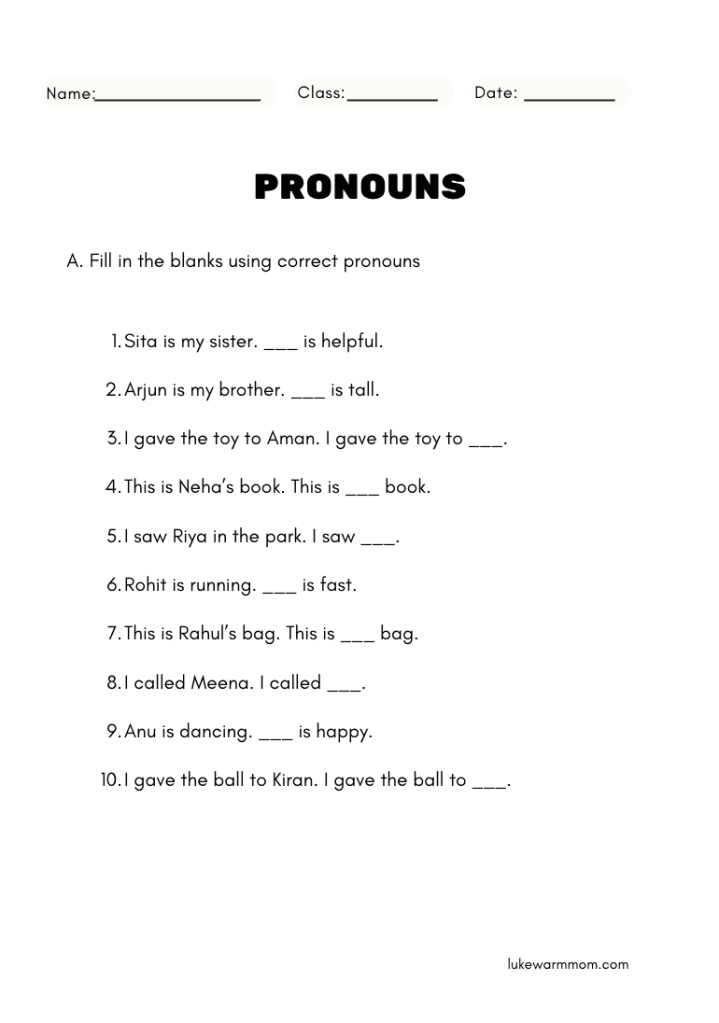
This printable is perfect for:
- Grade 1 and Grade 2 kids
- homeschooling practice
- quick revision at home
Learning pronouns takes practice, but with simple worksheets and everyday examples, kids can understand them quickly.
Keep it light, keep it consistent, and most importantly — make it fun.
If you enjoyed these worksheets, you can download the complete Parts of Speech worksheet bundle with 18 printable worksheets for free. Just sign up below and we’ll send you access to the full bundle so your child can continue practicing grammar lessons.
Hands-On Pronoun Cut and Paste Worksheets | Grade 1 & 2 Grammar Bundle

Frequently Asked Questions (FAQs)
1. What is the difference between he, him, and his?
He is used as a subject (He is playing).
Him is used as an object (I gave it to him).
His shows possession (This is his book).
2. What is the difference between she and her?
She is a subject pronoun (She is reading).
Her can be used as an object (I saw her) and also to show possession (This is her bag).
3. At what age should kids learn he, she, him, and her?
Most children start learning basic pronouns like he and she in early primary grades (around ages 5–7). Object and possessive forms like him, her, and his are usually introduced soon after with practice.
4. How can I teach pronouns to kids easily?
The best way to teach pronouns is through:
- simple examples in daily conversations
- worksheets and practice activities
- using names first, then replacing them with pronouns
For example:
“Riya is playing” → “She is playing”
5. Why do kids confuse him and his?
Children often confuse him and his because both refer to a boy, but they are used differently:
- Him is used after an action
- His shows ownership
Regular practice with sentences helps clear this confusion.
6. Are these worksheets suitable for Grade 1 and Grade 2?
Yes, these worksheets are designed for Grade 1 and Grade 2 students. They use simple sentences and easy activities to help children understand pronouns step by step.
7. Can I download these worksheets as a PDF?
Yes, you can download a free printable PDF version of these worksheets to practice offline at home or in the classroom.
8. How often should kids practice pronouns?
Short, regular practice works best. Even 5–10 minutes a day using worksheets or simple sentences can help children learn pronouns quickly and confidently.
More Class 1 Worksheets You May Like
- Position Words Worksheet for Grade 1
- Describing Words Worksheets for Class 1 (Free Printable PDFs)
- Naming Words Worksheets for Grade 1 (Free Printable PDFs)
- Doing Words for Grade 1: Easy Guide + Free Printable Worksheets
- am, is, are + ing Worksheets for Grade 1 with Answers (Free Printable PDFs)
- Free Picture Comprehension Worksheets for Kids (Grade 1–3) + Printable PDF
- A, An, The Worksheets for Class 1 (Free Printable PDF)
- This, That, These, Those Worksheets (Free Printable PDF)
Subscribe for more tips, activities, and guidance to support your child’s learning and growth.
If you’re looking for more learning worksheets for early elementary children, you can explore our growing collection of skill-based practice resources designed for ages 5–8. From language and reading skills to simple grammar concepts, these worksheets are created to support gentle, stress-free learning at home.




Leave a Reply