
Table of Contents
Helping children learn when to use do and does is an important step in developing strong grammar skills. These free printable worksheets provide simple practice that helps first graders understand how verbs change depending on the subject of a sentence.
Whether you are a parent, teacher, or homeschool educator, these worksheets offer an easy way to reinforce subject-verb agreement through age-appropriate activities.
What Is Subject-Verb Agreement?
Subject-verb agreement means that the verb in a sentence must match the subject.
In the present tense, some verbs change depending on whether the subject is singular or plural. Young learners often find this concept challenging at first, which is why repeated practice is helpful.
The words do and does are among the most common verbs children encounter in early grammar lessons. Understanding how to use them correctly helps students build a strong foundation for reading and writing.
When Do We Use “Do”?
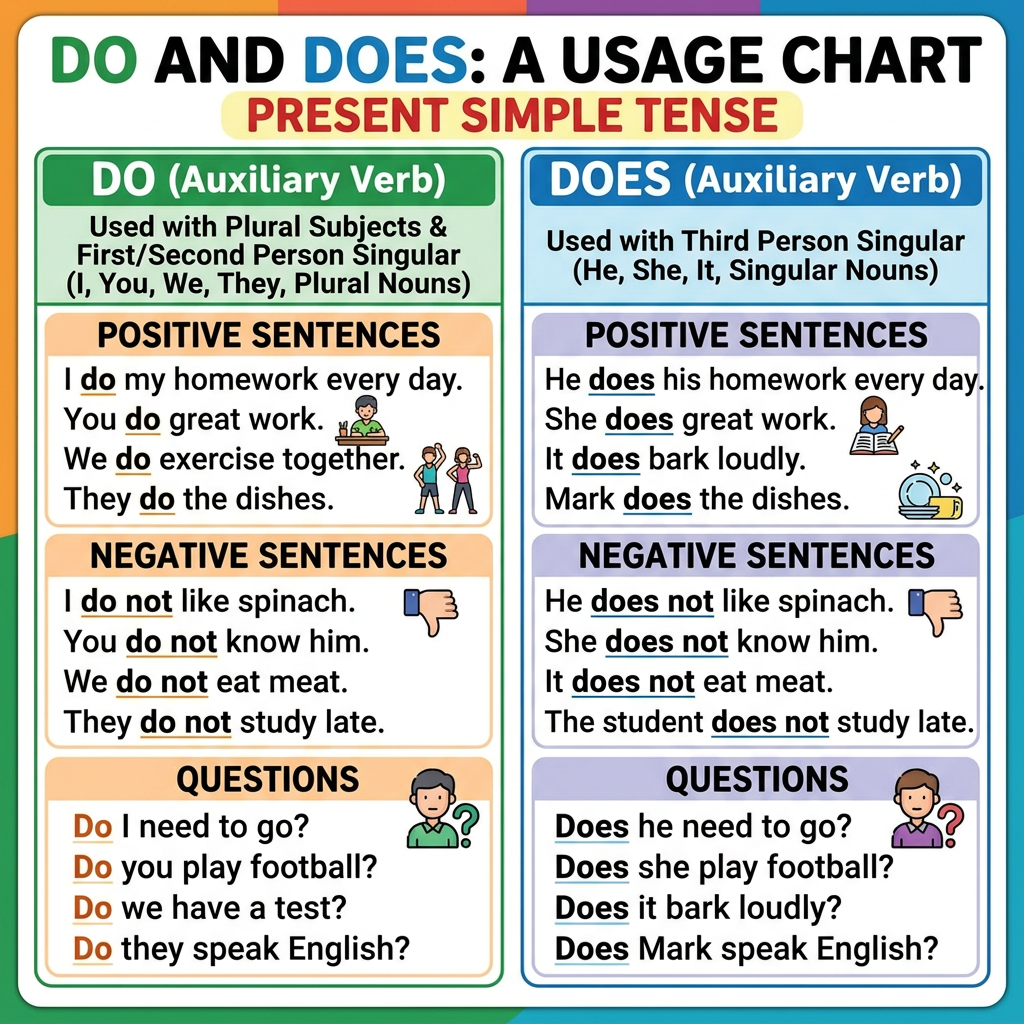
The word do is used with plural subjects and with the pronouns I, you, we, and they.
As children read and write more sentences, they begin to notice that do stays the same with these subjects. Recognizing this pattern helps them make correct grammar choices independently.
Use do with:
- I
- You
- We
- They
Examples:
- I do my homework.
- They do their chores.
When Do We Use “Does”?
The word does is used with singular third-person subjects such as he, she, and it.
This is often one of the first examples children see of a verb changing to match the subject. Practicing this pattern helps students understand that verbs can look different depending on who or what is performing the action.
Use does with:
- He
- She
- It
Examples:
- He does his homework.
- She does her work carefully.
Why Is It Important to Learn Do and Does?
Learning the correct use of do and does supports many areas of language development.
Children who understand subject-verb agreement are often better able to:
- Write complete sentences
- Communicate ideas clearly
- Improve reading fluency
- Recognize common grammar patterns
- Build confidence in written work
These skills continue to be important as students progress through higher grades.
What’s Included in These Worksheets?
This printable packet focuses on helping children identify and use do and does correctly.
Activities may include:
- Choosing the correct verb
- Completing sentences
- Reading and identifying correct grammar
- Simple sentence-building tasks
- Review exercises for independent practice
The worksheets are designed with beginning learners in mind and use straightforward language that is easy to understand.
Download Your Free Do and Does Worksheets
Ready to practice subject-verb agreement? Download the free printable worksheets and help your child build confidence using do and does correctly.

Answer Key
- does
- do
- does
- do
- does
- do
- does
- do
- do
- does

Answer Key
- do
- does
- do
- does
- do
- does
- do
- does
- do
- does
Continue Learning Subject-Verb Agreement
Once children are comfortable using do and does, they can move on to other subject-verb agreement skills. Another common grammar topic is learning when to use has and have correctly.
Like do and does, the choice between has and have depends on the subject of the sentence. Practicing both concepts helps children build a stronger understanding of grammar patterns and sentence structure.
Explore our Has and Have Worksheets for Kids to continue practicing subject-verb agreement.
Who Can Use These Worksheets?
These worksheets are ideal for:
- Grade 1 students
- Grade 2 students who need extra practice
- Homeschool families
- Classroom literacy centers
- Morning work activities
- Homework assignments
- Grammar review sessions
Because the activities are simple and focused, they can be used in a variety of learning settings.
Tips for Teaching Do and Does
When introducing subject-verb agreement, it can be helpful to start with short sentences and familiar subjects.
Encourage children to identify the subject first before choosing the correct verb. As they become more comfortable with the pattern, they will begin to recognize when to use do and does automatically.
Reading simple books aloud and discussing sentence patterns can also reinforce the concept in a natural way.
More Grammar Worksheets You May Like
- Position Words Worksheet for Grade 1
- Have and Has Worksheets for Kids(Free Printable)
- Describing Words Worksheets for Class 1 (Free Printable PDFs)
- Naming Words Worksheets for Grade 1 (Free Printable PDFs)
- Doing Words for Grade 1: Easy Guide + Free Printable Worksheets
- am, is, are + ing Worksheets for Grade 1 with Answers (Free Printable PDFs)
- Free Picture Comprehension Worksheets for Kids (Grade 1–3) + Printable PDF
- A, An, The Worksheets for Class 1 (Free Printable PDF)
- This, That, These, Those Worksheets (Free Printable PDF)
This version will likely perform better than a short post because it naturally includes terms like subject-verb agreement, do and does, grammar worksheets, Grade 1, homeschool, and language arts multiple times without feeling repetitive.
Frequently Asked Questions
What is subject-verb agreement?
Subject-verb agreement means that the verb must match the subject of the sentence. A singular subject takes a singular verb, while a plural subject takes a plural verb.
What is the difference between do and does?
Do is used with I, you, we, and they. Does is used with he, she, and it.
Learning this pattern helps children write grammatically correct sentences.
At what age do children learn do and does?
Many children are introduced to do and does in Grade 1 or Grade 2 as part of their grammar lessons. The exact timing may vary depending on the curriculum and learning pace.
Why do students confuse do and does?
Children often focus on the action in a sentence and forget to check the subject. Regular practice helps them recognize that the choice between do and does depends on who or what is performing the action.
Are these worksheets suitable for Grade 1?
Yes. These worksheets are designed for Grade 1 students and use simple sentence structures that support beginning grammar learners.
Can these worksheets be used for homeschooling?
Absolutely. The worksheets can be used for homeschool lessons, extra practice, independent work, or grammar review activities.
How can I help my child remember when to use does?
A simple strategy is to remind children that he, she, and it usually go with does. Repeated exposure through reading, writing, and worksheet practice can help reinforce this pattern.
Can Grade 2 students use these worksheets?
Yes. Grade 2 students who need additional review or reinforcement of subject-verb agreement can also benefit from these activities.
What grammar skill do these worksheets teach?
These worksheets focus on subject-verb agreement, specifically the correct use of do and does in present-tense sentences.
What should children learn after do and does?
After learning do and does, children often move on to other subject-verb agreement patterns such as has and have, is, am, and are, and regular verbs like play/plays and run/runs.
Subscribe for more tips, activities, and guidance to support your child’s learning and growth.
If you’re looking for more learning worksheets for early elementary children, you can explore our growing collection of Parts of Speech Worksheets for Kids designed for ages 5–8. From language and reading skills to simple math concepts, these worksheets are created to support gentle, stress-free learning at home.




Leave a Reply