

The first few minutes of an ELA class don’t have to be spent taking attendance while students stare at their desks. A good ELA classroom warm-up can get students talking, thinking, reading, writing, and using language before the main lesson even begins. The best warm-up activities are short, require little preparation, and give students a reason to participate. From tongue twisters and word races to collaborative storytelling, scenario-based conversations, and famous-line challenges, these ELA warm-ups can work for elementary, middle school, and high school students with a little adjustment.
Why Use ELA Warm-Ups?
A short warm-up can help students transition into English class and shift their attention toward language.
ELA warm-ups can be used to practice:
- Vocabulary
- Speaking and listening
- Grammar
- Reading comprehension
- Creative writing
- Critical thinking
- Literary knowledge
- Communication skills
- Fluency and confidence
You don’t need a different activity every day, either. A few reliable warm-ups that students recognize can become part of your regular classroom routine.
1. Build a Story One Line at a Time
This is a simple creative writing warm-up that can quickly become surprisingly funny.
Start with one sentence:
“When Maya opened the door, she immediately knew something was wrong.”
The first student adds one sentence.
The next student continues the story with another sentence.
Keep going until everyone has contributed.
Make it more challenging
Give students a rule such as:
- Every sentence must begin with a different letter.
- Someone must introduce a new character.
- The story must contain three specific vocabulary words.
- The ending must include a surprise.
- Every student gets exactly 10 seconds to continue the story.
For older students, ask them to think about plot, characterization, conflict, and point of view while they contribute.
Quick variation: One-line story
Put students into groups of 4–5. Each student writes exactly one line before passing the paper to the next person.
At the end, read the completed stories aloud.
2. Tongue Twister Challenge
Tongue twisters are an easy way to get students speaking immediately.
You can find funny and educational tongue twisters sorted age-wise here.
Try:
“Red leather, yellow leather.”
Or:
“She sells seashells by the seashore.”
Start slowly. Then have students repeat the phrase three times, gradually increasing their speed.
Turn it into an ELA challenge
Ask students to:
- Identify the repeated sounds.
- Find examples of alliteration.
- Write their own tongue twister.
- Create a tongue twister using the week’s vocabulary words.
For example, if students are learning words beginning with S, challenge them to create a sentence containing as many S sounds as possible.
3. Scenario-Based Conversation Starters
Give students a situation and ask them to discuss what they would say or do.
These work particularly well as speaking warm-ups.
I have put together a set of Scenario-Based Conversation Starters for Kids of elementary school ages here.
Try these scenarios:
Scenario 1:
Your friend borrowed your favorite book and returned it with several pages torn.
What would you say?
Scenario 2:
You accidentally receive a message meant for someone else. It contains a secret.
What do you do?
Scenario 3:
Your teacher announces that your class is getting one completely free day with no homework.
What would you do with it?
Scenario 4:
You discover that your best friend has written a story about you—but changed your name.
Would you read it?
Scenario 5:
You have to convince your parents to let you go on a school trip.
What arguments would you use?
Make it an ELA activity
Don’t stop at “What would you do?”
Ask students to think about tone and word choice.
How would you say the same thing if you were:
- Angry?
- Nervous?
- Excited?
- Being extremely polite?
- Talking to your best friend?
- Talking to your principal?
This turns a simple conversation starter into a lesson about register, tone, dialogue, and audience.
4. Word Race
Write a category on the board and give students 60 seconds.
For example:
Words related to weather
Students write as many words as they can.
After one minute, compare answers.
Try different categories
- Words beginning with B
- Adjectives describing a person
- Words related to mystery
- Words that rhyme with “light”
- Verbs used in a story
- Words related to emotions
- Words containing the letter combination “sh”
- Words associated with summer
- Words that can be both nouns and verbs
Make it competitive
Students get:
1 point for every correct word.
2 points for a word nobody else has.
This is a particularly useful warm-up when you want students to expand their vocabulary quickly.
5. English Stories vs. Russian Stories
This can become a fascinating literature discussion warm-up.
Choose a familiar story that exists in different cultural traditions or compare the storytelling traditions students are familiar with.
For example, ask:
What feels different about the way stories are told in English-language literature compared with Russian literature?
You could introduce examples from authors such as Leo Tolstoy, Fyodor Dostoevsky, Anton Chekhov, Charles Dickens, Jane Austen, or Mark Twain, depending on the age of your students.
Ask students:
- What kinds of characters do you notice?
- Is the writing humorous, serious, dramatic, or philosophical?
- How important is the setting?
- How are families portrayed?
- How do characters communicate?
- Does the story focus more on action or internal thoughts?
- What makes the writing feel “Russian” or “English” to you?
There isn’t necessarily one correct answer. The goal is to get students thinking about culture, storytelling, voice, characterization, and writing style.
For younger students, you can simplify the discussion by comparing two versions of a familiar fairy tale.
6. Who Wrote This?
Write a famous line from a literary work on the board.
Don’t reveal the author.
Ask students:
Who do you think wrote this?
Give them three possible answers—or let them guess freely.
For example, use recognizable lines from famous works you’ve already studied.
Students can discuss:
- Who wrote it?
- What book is it from?
- What clues helped you?
- What do you think the line means?
- What kind of writer might have written it?
This activity can become a great introduction to authors, novels, poetry, and literary movements.
For older students
Give them several lines and ask them to match:
Famous line → Author → Work
You can make this progressively harder by using lines that are recognizable to well-read students but aren’t immediately obvious.
7. Famous Poems: Can You Recognize the Line?
Put one memorable line from a poem on the board.
Ask students to identify:
The poem
The poet
What the line means
You could use well-known works by poets such as:
- Robert Frost
- Emily Dickinson
- William Shakespeare
- William Wordsworth
- Edgar Allan Poe
- Maya Angelou
- Langston Hughes
Then ask:
What made this particular line memorable?
This shifts the activity beyond memorization and encourages students to think about imagery, rhythm, metaphor, sound, and word choice.
8. What’s Your Favorite Book?
This sounds simple, but it can lead to a much deeper ELA conversation.
Instead of asking only:
“What’s your favorite book?”
Ask:
What is your favorite book, and what do you like about the author’s writing style?
Students might talk about:
- Humor
- Description
- Dialogue
- Vocabulary
- Characters
- Pacing
- World-building
- Emotional writing
- Mystery
- Suspense
- Poetry
- The way the author creates atmosphere
Then ask a follow-up:
Would you read another book by the same author? Why?
For students who don’t have a favorite author, ask:
What kind of writing do you enjoy most?
This makes the conversation accessible even to students who aren’t enthusiastic readers.
9. Describe a Book Without Saying Its Name
Choose a book that most of the class knows.
Describe it without giving away the title.
For example:
“The main character is a young boy who discovers that his ordinary life is not quite as ordinary as he thought. He eventually enters a completely different world and discovers that he has an important role to play.”
Can students guess the book?
Then let students create their own descriptions.
Challenge
They cannot mention:
- The title
- The author’s name
- Character names
- The setting
This encourages students to practice descriptive language and summarizing.
10. One Word, Many Sentences
Put one word on the board.
For example:
RUN
Ask students to create different sentences using the same word.
- I run every morning.
- The river runs through the village.
- The machine runs on electricity.
- The paint ran down the wall.
- She ran for class president.
Then ask:
Does the word mean exactly the same thing in every sentence?
This is a great way to introduce multiple meanings, context, parts of speech, and vocabulary.
11. Change the Tone
Write one simple sentence:
“I can’t believe you did that.”
Ask students to say it in different ways.
Excited
Angry
Shocked
Amused
Disappointed
Sarcastic
Then discuss:
What changed?
The words stayed almost exactly the same, but the tone, expression, punctuation, and context changed the meaning.
This makes a quick and effective introduction to dialogue and tone.
12. Continue the Dialogue
Give students two lines:
“You actually came.”
“I said I would.”
Ask students to write what happens next.
Who are these people?
Where are they?
Why did one person doubt the other?
What happened before this conversation?
Students can write three to five lines of dialogue before sharing their ideas.
13. Would You Rather? — ELA Edition
Regular “Would You Rather?” questions become more useful when they involve language and literature.
Try:
Would you rather live inside your favorite book or meet your favorite author?
Would you rather be able to write amazing stories or give amazing speeches?
Would you rather know how every mystery ends or never know what happens next?
Would you rather read only fiction or only nonfiction for a year?
Would you rather rewrite the ending of a book you dislike or write a sequel?
The important part is the follow-up:
Why?
Students have to explain their reasoning rather than simply choosing an answer.
14. Fix the Boring Sentence
Write a deliberately boring sentence:
“The boy walked into the room.”
Challenge students to make it more interesting.
They could write:
“The exhausted boy dragged himself into the dark room.”
Then ask:
What changed?
Students can identify:
- Stronger verbs
- Adjectives
- Adverbs
- Descriptive details
- Mood
- Setting
This makes a great writing warm-up before a creative writing lesson.
15. Three Words, One Story
Give students three unrelated words.
For example:
umbrella — dinosaur — library
They have two minutes to create a mini-story using all three.
Other combinations:
moon — sandwich — detective
train — chocolate — storm
robot — garden — violin
For older students, add a fourth requirement:
Include one metaphor.
or
Include one line of dialogue.
16. Finish the Sentence
Put sentence starters on the board.
If I could change one thing about school, I would…
The strangest thing I have ever seen was…
If books could talk, they would…
The best character in a story is…
I would never want to meet a villain who…
Students choose one and complete it in two or three sentences.
This works particularly well when students need a few quiet minutes to settle before discussion.
17. The 30-Second Book Pitch
Give students 30 seconds to convince the class to read a book.
They need to include:
- The title
- The genre
- A basic description
- One reason to read it
But they cannot give away the ending.
This practices concise speaking, persuasion, summarizing, and audience awareness.
18. Mystery Word
Choose a vocabulary word but don’t reveal it.
Give students clues one at a time.
For example:
It is an adjective.
It describes something very old.
It begins with “a.”
It has seven letters.
Students try to guess the word.
For an advanced version, give students a sentence containing the mystery word and ask them to infer its meaning from context.
19. Rewrite the Ending
Give students a familiar story and ask:
What if the ending were completely different?
For example:
- What if Cinderella didn’t go to the ball?
- What if the wolf wasn’t the villain?
- What if the hero failed?
- What if the main character never opened the mysterious door?
Students can write a new ending in five minutes.
This is especially useful for discussing plot, character choices, conflict, and alternate perspectives.
20. The Daily ELA Challenge
If you don’t want to decide on a new activity every morning, create a weekly rotation.
Monday — Word Warm-Up
Vocabulary, word races, synonyms, antonyms, or mystery words.
Tuesday — Talk Warm-Up
Scenario-based conversations, Would You Rather, or book discussions.
Wednesday — Writing Warm-Up
One-line stories, three-word stories, or sentence expansion.
Thursday — Literature Warm-Up
Famous lines, author recognition, poetry, or book discussions.
Friday — Fun Language Challenge
Tongue twisters, word games, literary trivia, or student-created challenges.
This gives students a predictable routine while still keeping the activities varied.
How Long Should an ELA Warm-Up Be?
Most classroom warm-ups don’t need to take more than 5–10 minutes.
The goal isn’t to teach an entire lesson during the warm-up. It is simply to get students mentally ready for the ELA class.
A good warm-up should be:
- Quick to explain
- Easy to start
- Relevant to language or literature
- Flexible enough for different ability levels
- Interesting enough to encourage participation
You can also reuse the same activity with different content. A word race, for example, can become a vocabulary warm-up one week and a literature warm-up the next.
Final Thoughts
A good ELA classroom warm-up doesn’t have to involve a worksheet. Sometimes the most effective way to start English class is simply to give students something interesting to say, write, solve, or debate.
Try a one-line story when you want creativity, a tongue twister when you want energy, a word race when you want vocabulary practice, or a literary quote when you want students thinking about books and authors.
The key is to make those first few minutes count—and give students a reason to use English before the main lesson begins.
If you’re looking for more back-to-school printables, classroom activities, and ideas to help you plan for the new school year, you may find this helpful collection of back to school guides and inspiration useful. It includes practical resources for teachers and parents to make the transition back to school easier, more organized, and more engaging for students.
- Classroom Rules Chart for Elementary Classrooms
- Scenario-Based Conversation Starters for Kids
- Meet the Teacher Templates: A Simple Way to Welcome Students and Families
- 50 Fun Brain Break Games for the Classroom
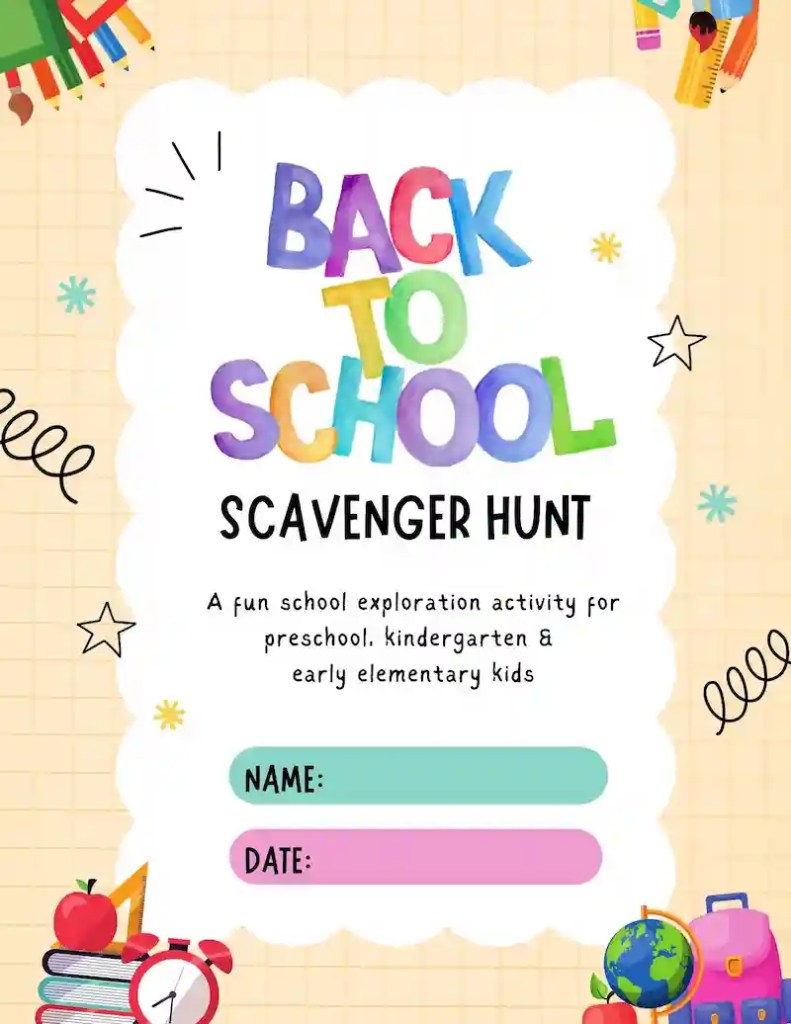
- Back-to-School Scavenger Hunt (Free Printable)
If you liked this, you can explore more of our low-pressure learning for early elementary activities to make elementary learning enjoyable for kids and teachers.




Leave a Reply