
Teaching children when to use many and much can be challenging at first. Since both words refer to quantity, students often confuse them in writing and speaking. These many and much worksheets provide hands-on practice that helps children understand the difference between countable and uncountable nouns while building strong grammar skills.
Whether you are a teacher, homeschool parent, ESL instructor, or tutor, these printable worksheets make learning grammar simple and engaging.
What Are “Many” and “Much”?
Many and much are words we use to talk about quantities.
Although they have similar meanings, they are used with different types of nouns.
Use “Many” with Countable Nouns
Countable nouns are things we can count individually.
Examples:
- one apple, two apples, three apples
- one book, two books
- one pencil, two pencils
Sentences with many:
- How many apples are in the basket?
- There are many students in the classroom.
- We have many crayons to share.
Use “Much” with Uncountable Nouns
Uncountable nouns are things we cannot count one by one.
Examples:
- water
- milk
- sugar
- rice
- time
Sentences with much:
- How much water is in the bottle?
- We do not have much time.
- There isn’t much sugar left.
Quick Trick for Kids
Ask this question:
Can I count it?
✔ If yes, use many.
- many books
- many toys
- many flowers
✔ If no, use much.
- much water
- much milk
- much sand
This simple rule helps children make the correct choice in most situations.
Why Do Students Confuse Many and Much?
Many young learners understand the meanings of the words but struggle to identify whether a noun is countable or uncountable.
Common mistakes include:
❌ How many water do you need?
✔ How much water do you need?
❌ There is much pencils on the desk.
✔ There are many pencils on the desk.
Regular practice helps students recognize patterns and use these words correctly in everyday communication.
Teacher Tip: Some nouns can be tricky. We say much money because “money” is usually treated as an uncountable noun. However, the units of money are countable, so we can say many coins or many dollars.
Teaching Tips for Parents and Teachers
1. Use Real Objects
Show children items around the house or classroom.
Ask:
- Can we count these pencils?
- Can we count this water?
Help them decide whether to use many or much.
2. Sort Nouns into Groups
Create two columns:
Many
- books
- chairs
- apples
- crayons
Much
- milk
- juice
- rice
- time
Sorting activities strengthen understanding of countable and uncountable nouns.
3. Ask Daily Questions
Use simple conversations:
- How many friends do you have?
- How many toys are in your room?
- How much water did you drink today?
- How much homework do you have?
Real-life examples help children remember grammar rules.
4. Use Picture-Based Activities
Young learners often understand concepts better when they see pictures.
Show:
- several apples → many apples
- a glass of water → much water
Visual learning improves retention and engagement.
What Is Included in These Many and Much Worksheets?
These printable worksheets may include:
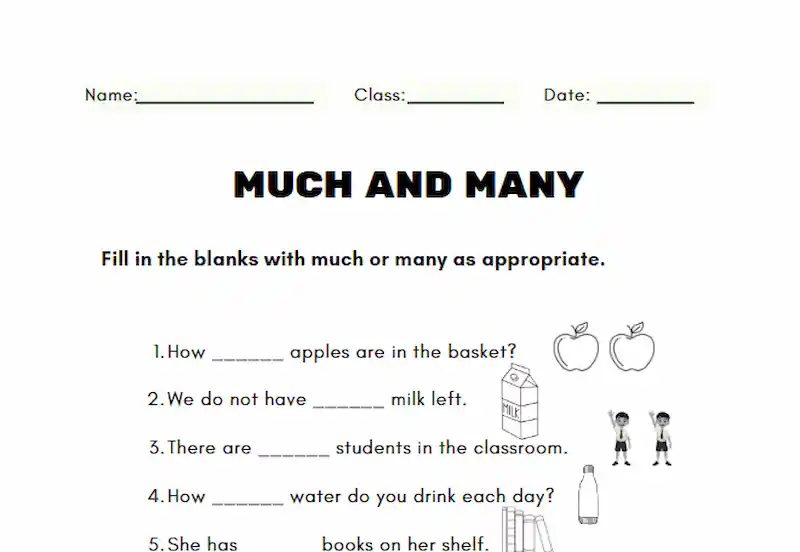
- Fill-in-the-blank sentences
- Circle the correct word activities
- Countable and uncountable noun sorting
- Sentence-writing exercises
- Multiple-choice questions
- Picture-based grammar practice
- Review activities for independent learning
These activities help students apply grammar rules instead of simply memorizing them.
Download Much and Many Worksheet Printables Here
Skills Students Will Practice
By completing these worksheets, students can learn to:
- Distinguish between countable and uncountable nouns
- Use many and much correctly in sentences
- Improve grammar accuracy
- Strengthen reading comprehension
- Build writing confidence
- Expand vocabulary
- Develop stronger English communication skills
Who Can Use These Worksheets?
These worksheets are suitable for:
- Grade 1 students
- Grade 2 students
- Grade 3 students
- ESL learners
- English language classrooms
- Homeschool programs
- Tutoring sessions
- Grammar review lessons
Teachers can use them as:
- Morning work
- Homework
- Independent practice
- Literacy centers
- Small-group instruction
- Assessment activities
Frequently Asked Questions
What is the difference between many and much?
Many is used with countable nouns, while much is used with uncountable nouns.
Is water many or much?
Water is an uncountable noun, so we say much water.
Is money countable or uncountable?
Money is generally treated as uncountable, so we often say much money.
At what grade should children learn many and much?
Most children begin learning these concepts in early elementary grades, especially Grades 1–3 and ESL programs.
Download Your Many and Much Worksheets
Give students plenty of practice with countable and uncountable nouns using these engaging many and much worksheets. With repeated exposure, children become more confident choosing the correct word and using grammar accurately in everyday speaking and writing.
Whether you are teaching in a classroom or at home, these printable worksheets offer a simple way to strengthen essential English grammar skills.
Understanding much and many helps children develop vocabulary, grammar skills, and a foundation for learning countable and uncountable nouns.
Related Grammar Worksheets
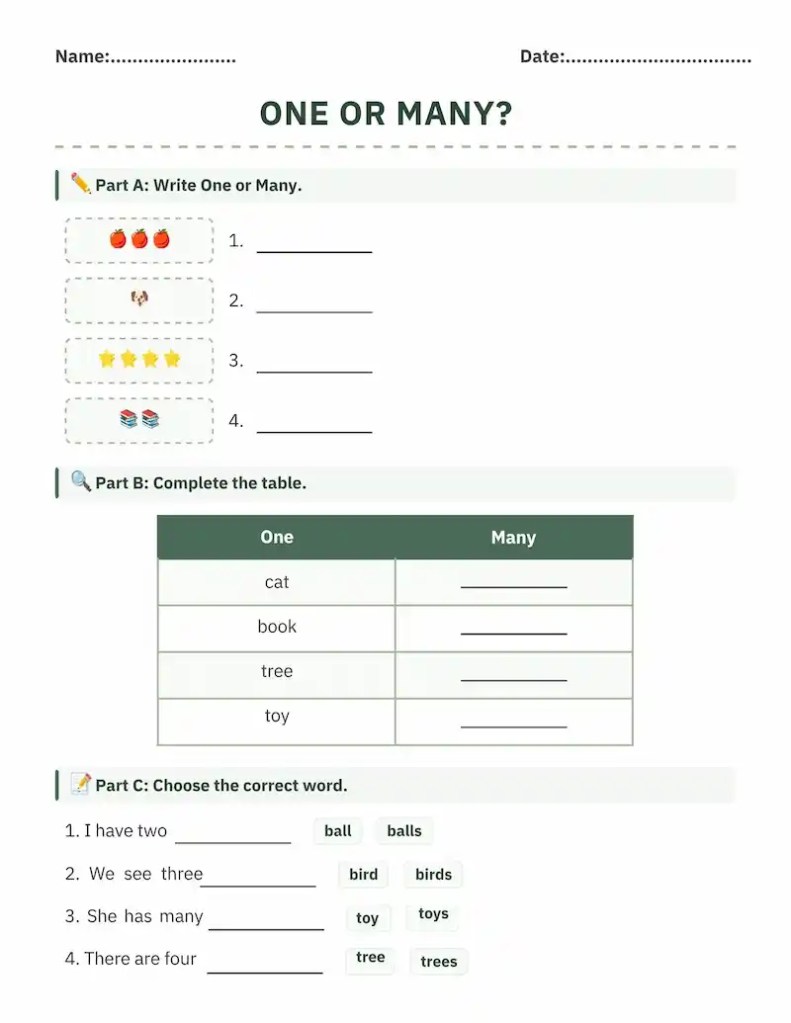
- One and Many Worksheets for Grade 1 (Free Printable PDF)
- Singular and Plural Nouns Worksheets
- This and These Worksheets
- Nouns for Grade 1 — Fun Noun Worksheets + Free Printable PDF
- Free Personal Pronoun Worksheets: He, She, It, I, You, We & They
- Sentence Structure Worksheets
- Am, Is, and Are Helping Verbs Worksheets
- am, is, are + ing Worksheets for Grade 1 with Answers ( Free Printable PDFs)
Learning much and many helps children understand actions and build clear, meaningful sentences. With simple practice and fun activities, Grade 1 kids can confidently identify countable and uncountable nouns and use them correctly in their everyday speaking and writing.
If you found this worksheet helpful, feel free to save it, print it, or share it with other parents and teachers
Happy learning!
If you’re looking for more learning worksheets for early elementary children, you can explore our growing collection of skill-based practice resources designed for ages 5–8. From language and reading skills to simple grammar concepts like parts of speech, these worksheets are created to support gentle, stress-free learning at home.



Leave a Reply