

Learning how to use some and any correctly is an important part of English grammar. These small words may seem simple, but they help us talk about people, places, animals, and things when we don’t know—or don’t need to say—the exact amount.
Students use some and any every day while speaking, reading, and writing. Whether they’re describing what’s in their lunchbox, asking a question in class, or writing a story, knowing which word to choose makes their sentences sound natural and grammatically correct.
This free Some vs Any worksheet gives students plenty of practice identifying the correct word in different kinds of sentences. It’s ideal for classroom lessons, homework, homeschool activities, grammar centers, independent practice, and ESL learning.
Free Some vs Any Worksheet PDF
Looking for a simple printable that helps children practice some and any?
This free worksheet includes age-appropriate practice designed for Grade 3, Grade 4, Grade 5, ESL, and ELL learners. Students will read each sentence carefully and decide whether some or any is the correct choice.
The worksheet works well for:
- Classroom grammar lessons
- Homework assignments
- Morning work
- Literacy centers
- English revision
- Homeschool activities
- Substitute teacher plans
- Extra grammar practice
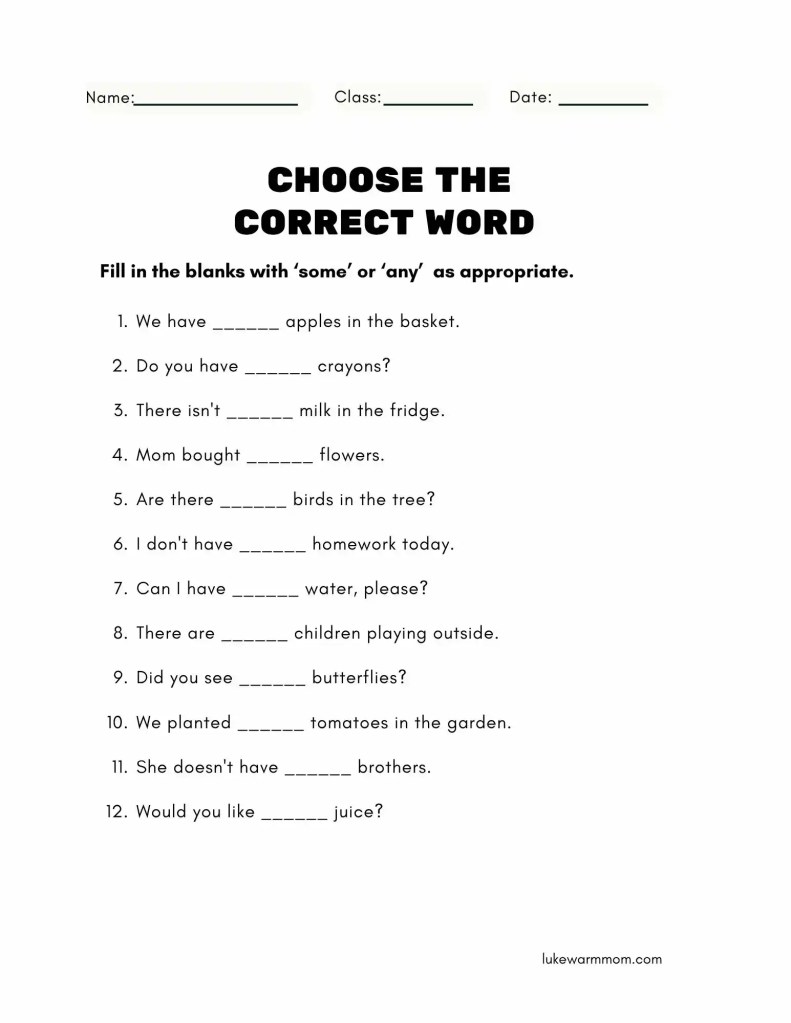
⬇️ Download your free Some vs Any Worksheet PDF below.
What Are “Some” and “Any”?
The words some and any are called determiners. A determiner comes before a noun and gives us information about the amount or quantity of something.
Instead of telling us an exact number, some and any describe an unspecified amount.
For example:
- I have some books.
- Do you have any books?
In both sentences, we know books are being discussed, but we don’t know exactly how many.
These words are used with both countable nouns and uncountable nouns.
Countable nouns
These are things we can count.
Examples:
- apples
- pencils
- cookies
- students
- toys
Example sentences:
- We bought some apples.
- Do you have any pencils?
Uncountable nouns
These are things we usually don’t count one by one.
Examples:
- milk
- water
- rice
- sugar
- homework
- information
Example sentences:
- There is some milk in the fridge.
- We don’t have any sugar.
Understanding whether a noun is countable or uncountable helps students use some and any correctly.
What Does “Some” Mean?
The word some usually means an unspecified amount or number.
We use some most often in positive (affirmative) sentences.
Examples:
- I have some crayons in my backpack.
- There are some birds in the tree.
- We bought some apples at the grocery store.
- She found some seashells on the beach.
- My teacher gave us some extra practice.
- Dad planted some flowers in the garden.
- Emma packed some snacks for the trip.
- The library has some new books.
Notice that each sentence tells us something exists, but it doesn’t tell us exactly how many.
That is the job of some.
Using “Some” in Offers and Requests
One exception to the basic grammar rule is that we also use some in polite offers and requests.
Examples:
- Would you like some juice?
- Can I have some paper, please?
- Would you like some cookies?
- May I borrow some crayons?
- Could I have some water?
Although these are questions, some sounds more friendly and natural because the speaker expects the answer might be “yes.”
This is something students become more comfortable with as they practice.
What Does “Any” Mean?
The word any also refers to an unspecified amount, but it is most commonly used in questions and negative sentences.
Questions
When asking if something exists, we usually use any.
Examples:
- Do you have any pencils?
- Are there any cookies left?
- Is there any milk in the refrigerator?
- Did you see any butterflies?
- Have you read any good books lately?
- Are there any seats available?
Here, the speaker doesn’t know the answer and is asking whether something exists.
Negative Sentences
We also use any after words like not, don’t, isn’t, and can’t.
Examples:
- I do not have any pencils.
- There aren’t any cookies left.
- We couldn’t find any mistakes.
- She doesn’t have any homework today.
- They didn’t see any dolphins.
- There isn’t any cheese in the fridge.
Using any makes these negative sentences sound natural and correct.
A Simple Rule to Remember
When students first learn this grammar topic, this simple pattern is a great place to start.
| Sentence Type | Word to Use |
|---|---|
| Positive sentence | Some |
| Negative sentence | Any |
| Question | Any |
| Offer | Some |
| Polite request | Some |
For example:
✅ We have some oranges.
✅ We don’t have any oranges.
✅ Do we have any oranges?
✅ Would you like some oranges?
Although English has a few exceptions, this rule works for most everyday situations and helps students build confidence before learning more advanced grammar.
Common Mistakes Students Make with Some and Any
Learning the difference between some and any takes practice. Many students mix them up because both words refer to an unspecified amount. Understanding a few common mistakes can make it easier to remember when to use each word.
1. Using any in positive sentences
❌ I have any crayons.
✅ I have some crayons.
When you are making a positive statement about something that exists, some is usually the correct choice.
2. Using some in negative sentences
❌ We don’t have some apples.
✅ We don’t have any apples.
Negative sentences usually use any after words like don’t, doesn’t, isn’t, aren’t, and can’t.
3. Using some in regular questions
❌ Do you have some pencils?
✅ Do you have any pencils?
When you’re simply asking whether something exists, any is the correct word.
Remember that some is used in questions only when making an offer or polite request.
Examples:
- Would you like some lemonade?
- Can I have some paper, please?
Can “Any” Be Used in Positive Sentences?
Yes! Once students understand the basic rule, they can learn one important exception.
Sometimes any means it doesn’t matter which one or every possible choice.
Examples:
- You may choose any book from the shelf.
- Sit in any chair.
- Pick any color you like.
- You can ask any teacher for help.
In these sentences, any means whichever one you want, not an unknown amount.
This is a more advanced use of the word, so younger students should first master the basic rule before learning these exceptions.
Tips for Teaching Some and Any
Students usually remember grammar best when they hear it in everyday conversations instead of only completing worksheets.
Here are a few easy ways to practice at home or in the classroom.
During snack time
Ask questions like:
- Do we have any apples?
- Would you like some juice?
- Is there any cheese left?
While packing a backpack
- Do you have any pencils?
- Put some notebooks in your bag.
- Do you need any erasers?
During grocery shopping
Encourage children to make simple sentences.
Examples:
- Let’s buy some bananas.
- We don’t need any milk.
- Do we have any bread at home?
Real-life conversations help children understand grammar naturally.
Classroom Activities for Practicing Some and Any
Looking for more ways to reinforce this grammar skill? Try these simple classroom ideas.
Sentence Sorting
Write sentences on cards. Students sort them into:
- Some
- Any
This helps them recognize patterns.
Picture Prompts
Show pictures of kitchens, classrooms, parks, or grocery stores.
Ask students questions like:
- Are there any birds?
- Can you see any cars?
- There are some flowers.
- I can see some children.
Partner Questions
Students ask each other questions using any.
Examples:
- Do you have any brothers?
- Do you have any pets?
- Did you eat any fruit today?
Their partner answers using some or any, depending on the sentence.
Who Is This Some vs Any Worksheet For?
This printable is designed for learners who are beginning to understand English grammar and sentence structure.
It is especially suitable for:
- Grade 3 students
- Grade 4 students
- Grade 5 students
- ESL learners
- ELL classrooms
- Homeschool families
- English tutoring
- Literacy centers
- Independent practice
- Homework assignments
- Grammar review lessons
- Substitute teacher activities
Whether students are learning English as a first language or as an additional language, this worksheet provides meaningful practice with one of the most common grammar topics.
Download the Free Some vs Any Worksheet PDF
Ready to help your students build confidence with some and any?
This printable worksheet provides simple, engaging practice that reinforces classroom learning while giving students opportunities to apply grammar rules independently.
Whether you’re a teacher preparing tomorrow’s lesson or a parent looking for extra practice at home, this worksheet is an easy way to strengthen grammar skills.
⬇️ Download your free Some vs Any Worksheet PDF here.
[DOWNLOAD BUTTON]
Related Grammar Worksheets
If your students are practicing some and any, they may also enjoy these printable grammar resources:
- Articles (A, An & The) Worksheets
- Much vs. Many Worksheets
- Plural Nouns Worksheets
- Pronouns Worksheets
- Parts of Speech Worksheets
- Subject and Predicate Worksheets
Practicing related grammar concepts helps students become more confident readers and writers.
Frequently Asked Questions
What is the difference between some and any?
Some is usually used in positive sentences, offers, and polite requests. Any is most often used in questions and negative sentences.
Examples:
- I have some books.
- Do you have any books?
- I don’t have any books.
When do children usually learn some and any?
Many students are introduced to some and any during Grades 2–4. Older students and ESL learners often revisit these concepts as part of grammar review.
Can some be used in questions?
Yes. We commonly use some in offers and polite requests.
Examples:
- Would you like some cake?
- Can I have some water, please?
Can any be used in positive sentences?
Yes. Sometimes any means it doesn’t matter which one.
Example:
- Choose any toy you like.
This is an advanced grammar use that students usually learn after understanding the basic rules.
Are some and any used with countable and uncountable nouns?
Yes.
Examples:
Countable:
- some apples
- any pencils
Uncountable:
- some water
- any sugar
Both words work with either type of noun depending on the sentence.
Is this worksheet suitable for ESL learners?
Yes. The worksheet uses clear sentence patterns and familiar vocabulary, making it appropriate for many English language learners.
Can I use this worksheet for homeschooling?
Absolutely. It works well for independent practice, grammar review, morning work, homework, and extra reinforcement at home.
What grade level is this worksheet designed for?
This printable is best suited for Grades 3–5, but it can also be used with older students who need extra grammar practice or ESL learners reviewing English fundamentals.
Mastering the difference between some and any helps students build stronger grammar skills and communicate more confidently in both speaking and writing. Although the rules may seem confusing at first, regular practice makes choosing the correct word much easier.
Use this free Some vs Any worksheet alongside classroom discussions, everyday conversations, and additional grammar activities to reinforce learning. With consistent practice, students will quickly recognize when to use some in positive statements and polite requests, and when any belongs in questions and negative sentences.
We hope this printable helps make grammar practice simple, engaging, and enjoyable for your learners. Happy learning!
Related Grammar Worksheets
- One and Many Worksheets for Grade 1 (Free Printable PDF)
- Many and Much Worksheets for Kids
- Singular and Plural Nouns Worksheets
- This and These Worksheets
- Nouns for Grade 1 — Fun Noun Worksheets + Free Printable PDF
- Free Personal Pronoun Worksheets: He, She, It, I, You, We & They
- Sentence Structure Worksheets
- Am, Is, and Are Helping Verbs Worksheets
- am, is, are + ing Worksheets for Grade 1 with Answers ( Free Printable PDFs)
Learning much and many helps children understand actions and build clear, meaningful sentences. With simple practice and fun activities, Grade 1 kids can confidently identify countable and uncountable nouns and use them correctly in their everyday speaking and writing.
If you found this worksheet helpful, feel free to save it, print it, or share it with other parents and teachers
Happy learning!
If you’re looking for more learning worksheets for early elementary children, you can explore our growing collection of skill-based practice resources designed for ages 5–8. From language and reading skills to simple grammar concepts like parts of speech, these worksheets are created to support gentle, stress-free learning at home.


Leave a Reply